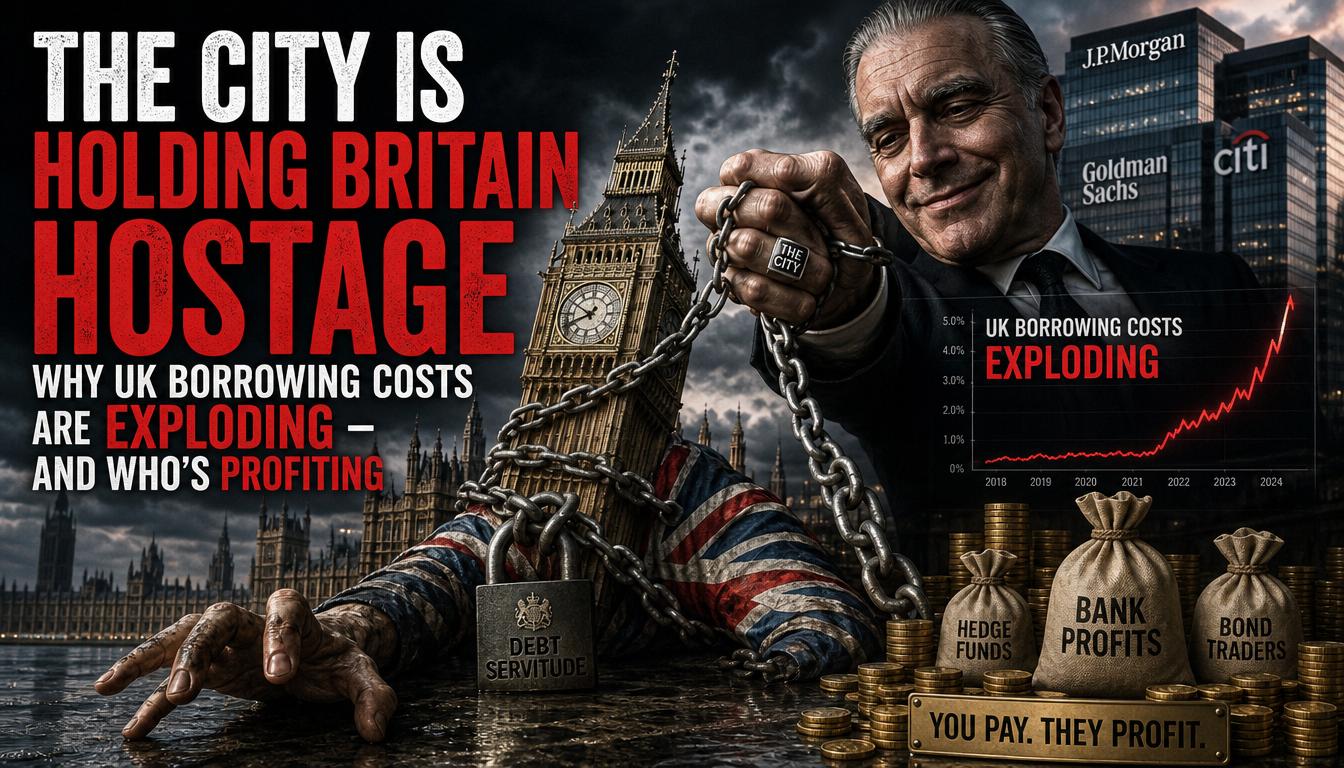
UK government borrowing costs are now above 5% on ten-year debt and over 5.75% on thirty-year debt. The headlines call this a crisis. The Chancellor calls it a constraint. The Treasury calls it a discipline. What none of them call it is what it actually is: a transfer.
To understand why, it helps to start with a question almost no one in the City asks out loud. Why is Britain — a country with its own currency, its own central bank, and a four-hundred-year unbroken record of never defaulting on sterling debt — paying significantly more to borrow than France or Italy, both of which use a currency they do not control? French ten-year debt yields under 3.5%. Italian debt yields under 4%. The UK is paying a premium that bears no relationship to economic fundamentals. Something else is driving this, and it is not the market doing its mysterious work.
The numbers the government would prefer you not check
Before going further, it is worth noting that almost every official figure surrounding this debate is, to put it politely, an approximation. UK GDP is reported at around £3 trillion, but roughly £300 billion of that is "imputed rent" — a notional figure for what homeowners would theoretically pay themselves to live in their own houses. They do not pay it. It is an accounting fiction. Strip it out, and real GDP is closer to £2.7 trillion.
The national debt is treated similarly. Official statistics include something called the "Bank of England contribution to the national debt", which is not a real thing — the Bank is owned by the government, so the government cannot owe debt to itself. The Debt Management Office (DMO) reports a debt of around £2.9 trillion, but £200 billion of that is debt the DMO owes to itself. The genuine figure is closer to £2.7 trillion. The state nevertheless pays — and reports — interest on the fictional portion. None of this is a conspiracy. It is simply how the books have been kept, and it conveniently inflates the apparent scale of the "problem".
Who actually owns this debt
Here, the data is reliable, and it tells a clear story.
| Holder | Share |
|---|---|
| Bank of England (QE reserves) | ~22% |
| UK commercial banks | ~27% |
| Pension funds & insurers | ~21% |
| Overseas holders | ~28% |
| UK households (directly) | <1% |
| Other | ~1% |
Overseas ownership is not the threat it is sometimes portrayed as. Foreign holders want sterling to settle international trade and they trust the UK never to default. Their holdings are a vote of confidence in the British economy, not a danger to it.
The figures that matter are the domestic ones. The Bank of England's holding is, in substance, the mirror image of the central bank reserve accounts created by quantitative easing — deposits held by UK commercial banks at the Bank of England. Add that to the 27% banks hold directly, and the UK banking and financial sector controls more than 45% of the national debt. Add pension funds and insurance companies, and over two-thirds of UK government debt sits in institutions that exist to manage the financial assets of the already-wealthy.
Less than 1% is held directly by ordinary citizens. This is not a debt owed by the nation to itself in any meaningful democratic sense. It is a debt owed by the public to a narrow band of institutions.
Where the £111 billion goes
The UK government paid approximately £111 billion in debt interest in 2025–26 — roughly one pound in every ten of total public spending. Where does it land?
| Recipient | £ billion |
|---|---|
| UK commercial banks (via BoE reserves & direct holdings) | ~49 |
| Pension funds & insurers | ~24 |
| Overseas holders | ~31 |
| UK households (directly) | ~1 |
| Other | ~6 |
| Total | ~111 |
The single largest line — close to £50 billion a year — goes to banks and financial institutions. The combined £73 billion flowing to UK banks, insurers and asset managers is the largest annual transfer of public money to wealth-management institutions in this country.
And here the distributional question becomes unavoidable. The top 10% of UK wealth-holders own roughly two-thirds of all financial assets, including pension entitlements. That means around £48 billion a year in gilt interest ultimately flows to the wealthiest tenth of the population — a sum almost equal to the entire UK defence budget, and more than the annual block grant paid to Scotland. The bottom 70% of households receive virtually none of it.
This is not a side-effect of debt servicing. It is the structural function of it.
The mechanism: how "the markets" discipline democracy
The orthodox story holds that bond yields rise because investors lose "confidence" in a government. In practice, the mechanism is more direct. When a UK government floats a policy that might benefit ordinary people — higher benefits, more NHS spending, public investment — financial institutions sell gilts. Selling pushes the price down. Because the coupon is fixed, the effective yield rises. The same institutions that triggered the sell-off now collect higher interest on their remaining holdings, and on every new gilt issued thereafter.
This is not a market signalling fiscal danger. It is a feedback loop. The wealthier the response demanded by the City, the more the City earns. The worse the conditions for ordinary households, the larger the extraction. Policies aimed at the roughly 14 million people living in poverty in the UK automatically trigger payments to the wealthiest.
The Bank of England superintends this arrangement. It keeps interest rates exceptionally high by European standards — Bank Rate is 3.75% in the UK against materially lower equivalents in much of the eurozone — partly to attract internationally mobile capital into the City of London, which continues to function as a tax haven for cross-border wealth. The British public pays for this through higher mortgages, higher business borrowing costs, and £111 billion a year in debt interest. The beneficiaries are the institutions and individuals who use the City to manage and shelter their money — the same institutions whose desks trade UK and global equity indices and dominate the global FX market in which sterling is priced.
What an honest government would do
None of this is inevitable. Four steps would change it.
The first is for the government to take back control of interest rates from the Bank of England. Operational independence is a policy choice introduced in 1997, not a law of nature, and other democracies set their rates differently.
The second is to cut the Bank Rate. There is no domestic-economy case for the UK paying more than a percentage point above its European peers; the gap is there to subsidise the City, not to fight inflation.
| Country | 10-yr yield | CPI | Debt / GDP | Policy rate |
|---|---|---|---|---|
| United Kingdom | 5.02% | 3.3% | ~100% | 3.75% |
| Germany | 2.54% | 2.9% | ~63% | 2.40% |
| France | 3.31% | 2.7% | ~115% | 2.40% |
| Italy | 3.87% | 1.6% | ~135% | 2.40% |
| Eurozone (avg) | 3.20% | 3.0% | ~88% | 2.40% |
Sources: Bank of England, ECB, Eurostat, ONS, Trading Economics, House of Commons Library Economic Indicators (April 2026).
Now, let me walk you through why this table is the strongest single piece of evidence. The orthodox defence of high UK borrowing costs rests on three claims, and the table dismantles each one in turn.
The first claim is that the UK has to pay more because its inflation problem is worse. Look at the third column. UK CPI is 3.3%, only 0.3 percentage points above the Eurozone's 3.0% and only 0.4 percentage points above Germany's 2.9%. Yet the UK's ten-year borrowing cost is 2.48 percentage points above Germany's. The inflation differential cannot explain a borrowing-cost differential that is more than six times as large as itself. Italy, even more strikingly, has inflation of just 1.6% — roughly half the UK's — and still borrows at 3.87%, which is well over a full percentage point cheaper than Britain.
The second orthodox claim is that the UK pays more because its debt burden is worse. Look at the fourth column, and the argument collapses entirely. UK government debt sits at roughly 100% of GDP. France's is around 115%. Italy's is around 135%. Both countries carry materially heavier debt loads than Britain, yet both borrow more cheaply. If debt levels genuinely drove yields, the UK should be borrowing at lower rates than Paris and substantially lower rates than Rome. The reverse is the case. This is what statisticians would call a falsifying observation: a single counter-example is enough to refute the rule, and here there are two of them sitting in the same table.
The third claim — that the UK pays more because it is somehow a less safe credit — runs into the same problem. The UK has never defaulted on sterling debt in over three centuries. It issues its own currency, controls its own central bank, and has no exchange-rate constraint of the kind eurozone members face. By every measure of structural sovereign credit risk, the UK is in a stronger position than any single euro member. Yet it pays the premium.
The third step is to reform the remuneration of central bank reserve accounts. The Bank currently pays full Bank Rate on around £650 billion of reserves created during QE — money it gave the banks in the first place. Japan and the eurozone tier these payments so that only part of the reserves earn the full rate. Doing the same in the UK could save roughly £10 billion a year. The current arrangement enriches bank shareholders; reform would return that money to the public.
The fourth, and most politically charged, is for the government to stop letting the City dictate terms. The City needs gilts — pension funds cannot pay out without them, banks cannot run the overnight repo market without them — far more than the government needs to borrow. The UK government creates its own money every time it spends; the Bank of England confirmed during the COVID crisis that it would extend the Treasury an overdraft facility if required, and before 2006 this kind of direct facility was routine. If the City attempts to hold the government to ransom by refusing to buy gilts at reasonable yields, the government can simply stop issuing them and finance itself directly. The City would then quickly discover who actually depends on whom.
A political choice, not an economic necessity
Britain's bond crisis is real, but it is not the crisis it is presented as. It is not the verdict of impartial markets on a profligate state. It is the predictable output of an institutional architecture that funnels public money into private wealth, overseen by a central bank whose priorities have drifted far from the public interest.
Rising gilt yields are not a disaster for everyone. For the City, they are the best business in town. The cost is borne by the millions of Britons living in poverty, by every household waiting for an NHS appointment, by every council shutting a library. The choice to keep paying that cost is political. And political choices can be unmade.