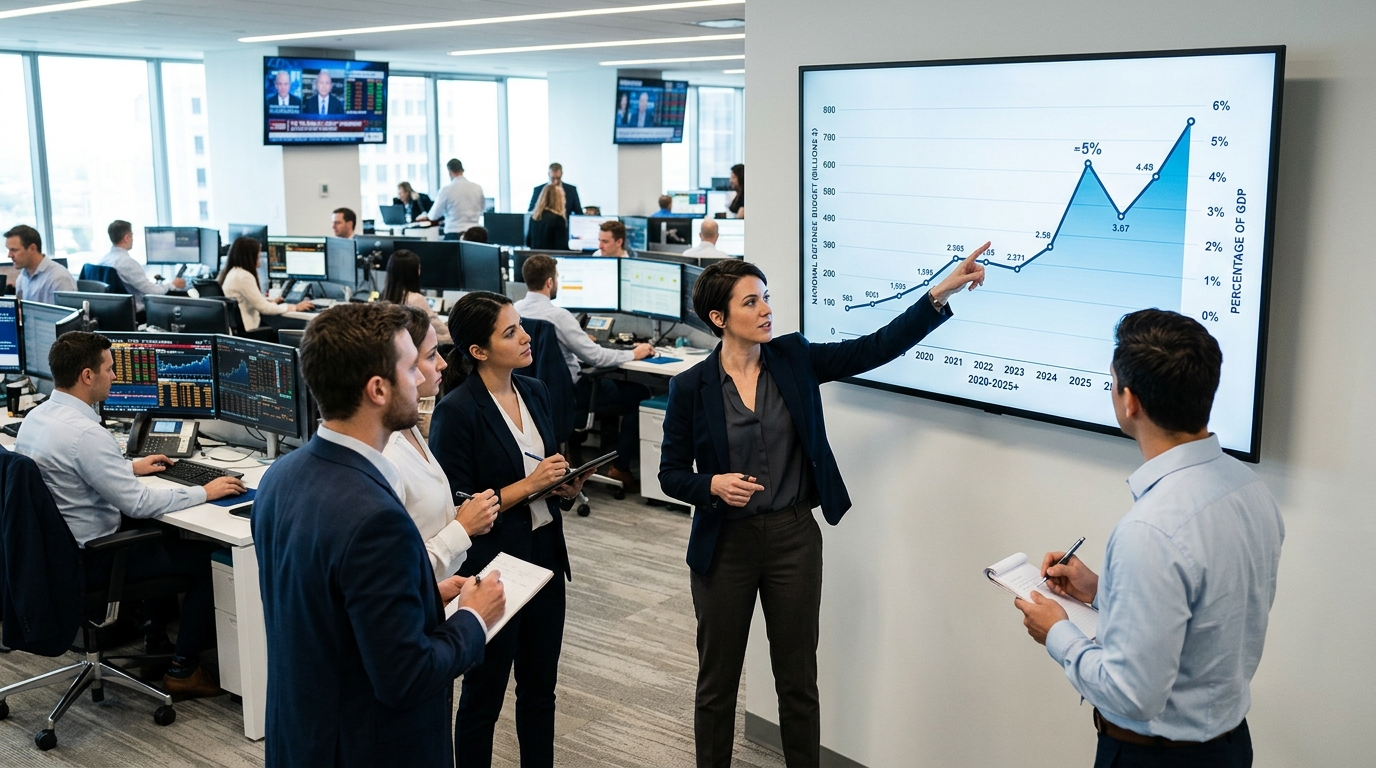
The '5% Reality Check' Movement is reshaping capital allocation across every major asset class in 2026, and the numbers are staggering: a 250% increase above the long-standing 2% NATO benchmark that Western democracies have coasted on for decades.
This is not a gradual policy adjustment. It is a structural regime change, and the market implications are already printing on charts across defense equities, commodities, sovereign bonds, and crypto.
Key Takeaways
| Question | Answer |
|---|---|
| What is the '5% Reality Check' Movement? | A coordinated policy push by Western nations to raise defense and strategic spending to 5% of GDP by 2035, replacing the outdated 2% NATO target with a benchmark calibrated for modern geopolitical risk. |
| Which sectors benefit most? | Defense contractors, dual-use tech firms, sovereign AI infrastructure providers, natural-resource companies and Arctic surveillance technology developers. |
| How does it affect R&D investment? | A 12% annual lift in R&D spending is projected, driven by dual-use technology mandates and the need to reduce dependence on Chinese-controlled supply chains. |
| Does it create trading opportunities? | Yes. Government spending surges of this magnitude historically produce multi-year uptrends in specific equity sectors and commodity markets. |
| Best tool to navigate these sectors? | MT5 Viper Strategy — non-repainting, MTF-confirmed signals across equities, commodities and crypto CFDs, purpose-built for high-volatility regimes. |
| Is the 5% target realistic? | China's defense spending grows ~5% per annum vs. ~2% for the U.S. — the movement argues 5% is necessary for competitive parity. |
| Prop firm impact? | Manual execution workflows are critical — behavioural detection systems are flagging algorithmic-looking entries during headline-driven volatility spikes. |
What Is the '5% Reality Check' Movement?
The '5% Reality Check' Movement is not a think-tank talking point. It is a coordinated political and economic campaign across NATO-aligned democracies to force a hard recalibration of what "adequate" national defense actually costs in a world defined by near-peer adversaries, contested Arctic routes, and fragmented global supply chains.
The core argument is binary: the 2% GDP benchmark was designed for a post-Cold War world that no longer exists. Five percent is the new floor if Western nations intend to stay operationally relevant through 2035.
Why the '5% Reality Check' Movement Is the Macro Theme of 2026
China's defense spending has grown at ~5% per annum. The U.S. has averaged ~2%. That gap is the entire thesis, and it is driving institutional capital rotation at a scale most retail traders are not yet positioned for.
The spending commitments being debated in 2026 across NATO capitals are not marginal budget lines. They are structural reallocation events that rewrite sector weightings across major indices for years, not quarters. For the parallel rate-cycle story see did central banks actually beat inflation and why the national debt is really the nation's savings.
Best Asset Classes to Watch Under the '5% Reality Check' Movement
- Defense Equities: Prime contractors and second-tier suppliers tied to sovereign procurement pipelines. These move early and fast on budget approval signals.
- Dual-Use Technology Firms: Companies producing systems usable in both military and civilian contexts — the clearest long-term beneficiaries of the dual-use mandate.
- Strategic Natural Resources: Re-categorised from economic advantages to strategic assets, particularly where they reduce dependence on Chinese-controlled supply chains. Commodity traders who miss this are reading outdated maps — see commodities.
- Sovereign AI Infrastructure: Independent compute capacity is now a stated policy priority — and the firms building it outside US hyperscale providers are entering a structural demand cycle.
- Arctic-Adjacent Assets: Newly viable shipping routes plus the rise of Arctic surveillance create a concentrated spending vector for geospatial and remote sensing firms.
Every one of these verticals produces price action that is volatile, spike-driven and directionally strong once institutional inflow tape confirms the move. Noise filters are not optional here — they are survival tools.
How the Movement Reshapes R&D and Tech Sector Signals
A 12% annual lift in R&D investment is projected as the movement prioritises dual-use technologies. That is not a one-year pop — that is a compounding trend that prints across multiple timeframes simultaneously, which is exactly the environment where multi-timeframe signal confirmation becomes critical.
Traders who try to catch the entire move on a single timeframe will get shaken out on every retracement. The signal system that wins here is one that only prints arrows where MTF momentum agrees, filtering pullbacks from genuine continuation moves. The MT5 Viper Strategy is built precisely for that.
Best Signal Approach for the '5% Reality Check' Movement in 2026
The movement generates a specific market behaviour pattern: long consolidation periods punctuated by sharp, policy-driven breakouts. This structure rewards two types of traders — those who wait for confirmation before entering, and those who size positions correctly relative to the volatility of the breakout.
Size positions for true volatility using ATR (Average True Range). Set stops at 1.5 to 2x ATR rather than fixed pip values. Defense sector stocks and commodities tied to this movement routinely gap 3–8% on announcement days, and a fixed pip stop will close you out before the real move develops.
The '5% Reality Check' Movement and Crypto Market Implications
The push for sovereign AI infrastructure and strategic technology independence has a direct crypto corollary. Nations building independent compute networks and reducing single-point dependence on US hyperscale providers are also re-evaluating decentralised settlement infrastructure.
This intersects directly with the Ethereum Spot ETF Second Wave thesis active in 2026, where institutional capital flows into ETH are being partially driven by strategic infrastructure narratives, not just speculative momentum. BTC and ETH both carry elevated volatility profiles during geopolitical spending announcement cycles — see crypto.
Prop Firm Traders and the '5% Reality Check' Movement: What Changes
The movement is creating macro volatility regimes that prop firms are not fully accounted for in their standard risk parameters. Headline-driven spikes across defense equities, energy commodities and currency pairs tied to NATO-member nations are producing daily range expansions that trigger prop firm drawdown limits if traders are not volatility-adjusted in their position sizing.
The second risk is behavioural. Traders chasing the narrative with automated entry logic are getting flagged in 2026. Pattern execution that looks algorithmic, even if discretionary, is being caught by behavioural detection systems. The Manual Pattern Stealth Strategy solves this directly — and the algorithmic trading detection guide maps exactly which execution patterns trigger flags.
Best Tools for Trading the '5% Reality Check' Movement in 2026
This is not a trade you catch once. It is a multi-year structural theme with recurring entry points as budget approvals, procurement contracts and policy milestones generate repeatable price action across affected sectors. The right toolkit has three non-negotiable components: a non-repainting signal system, ATR-aware position sizing, and MTF-confirmed entries that filter policy-driven noise from actual institutional momentum.
The Viper system maps directly onto the asset classes most affected by the movement's capital flows — covering forex, crypto, stocks and indices from M1 through H4. To translate the macro into a repeatable process, start with developing a trading strategy and how to backtest in MT5.
S/R Zone Integration: Catch Every Real Move, Skip Every Fake One
Defense and strategic sector equities affected by this movement do not move in straight lines. They move in step-patterns, pausing at structural supply and demand zones before the next leg. Traders who enter on signal alone without structural confirmation will get stopped out on those pauses.
Proprietary S/R Zone integration, built into the Viper system, provides the structural confirmation layer that turns a good signal into a high-conviction entry. The zone defines where institutional orders are resting. The Viper signal tells you when those orders are beginning to absorb. Together, they produce the binary you want: real move or fake move, clear from the first bar.
Conclusion
The '5% Reality Check' Movement is the defining macro narrative of 2026. It is restructuring government budgets, rewriting sector weightings across global indices, creating a 12% annual R&D growth trajectory, and producing the kind of sustained institutional inflow tape that active traders have not seen since the post-2008 defense build-up cycle.
The traders who capture this theme are not the ones watching the news. They are the ones with a volatility-adjusted signal system that confirms multi-timeframe momentum before printing an entry, sizes positions against ATR rather than fixed values, and never repaints a signal once the candle closes. Track ongoing macro on trending topics.
From The Blog
Explore more long-reads on markets, money & policy →
Deep dives on monetary policy, the bond markets, prop firms and the tools serious traders use on MT5.