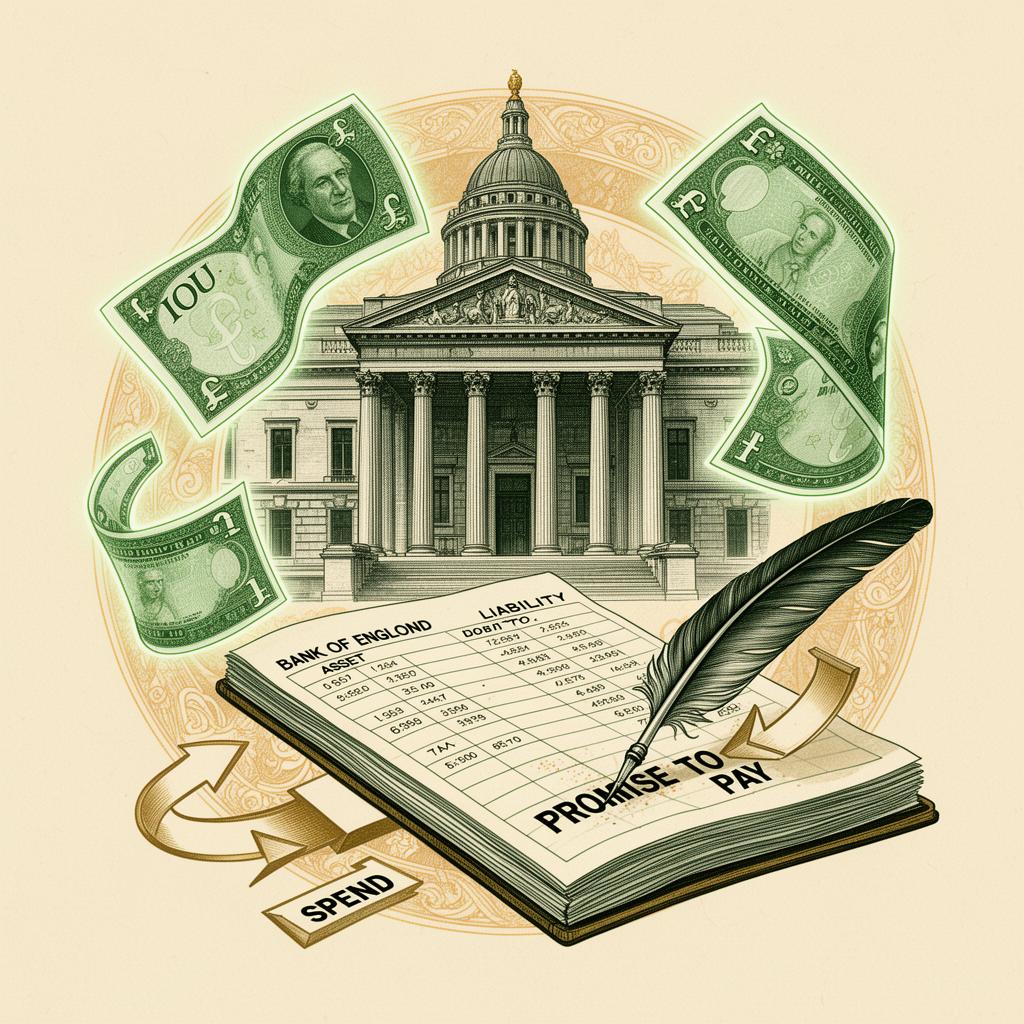
How a country that issues its own money actually pays for the things it buys — and why almost everything you have been told about "taxpayers' money" is, quite literally, the wrong way round.
Ask a politician how the country will pay for a new hospital and you will almost always hear the same answer: the money has to come from somewhere — from taxes, or from borrowing. The implication is that the government is like a household. It must earn before it can spend. Modern Monetary Theory (MMT) says this picture is not a moral failing or a political choice. It is simply wrong about the plumbing. For the companion mechanics, see money is a promise: how money is really created.
A government that issues its own currency, through a central bank acting on its behalf, does not collect money and then spend it. It creates money when it spends, and removes money when it taxes. Spending comes first. Nothing in the cycle requires the government to find revenue beforehand. That is not a hypothesis — it is a description of how the system already operates in the UK, the United States, Japan, and every other country with its own currency and central bank.
01 · Issuer or user? Everything turns on this
The household analogy is so familiar that it feels like common sense. But it quietly assumes the government is a user of the currency, just like you and me. It is not. The UK government, through the Bank of England, is the monopoly issuer of the pound. It can never run out of pounds in the way you can run out of pounds, for the same reason a scoreboard can never run out of points.
You and I, businesses, local councils and eurozone governments are all currency users: we must obtain money before we can spend it. A sovereign currency issuer is in a categorically different position. Confusing the two is the original error from which almost every "how will you pay for it?" question descends. The political consequences of this confusion are explored in UK national debt as the nation's savings.
02 · Spending creates money; taxation destroys it
When the Treasury instructs the central bank to make a payment — a nurse's salary, a supplier's invoice, a pension — the central bank simply credits the relevant bank account. New money comes into existence at that moment. There is no pre-existing pot being drawn down. When tax is later paid, money is withdrawn from the economy and, in accounting terms, destroyed. The cycle is: create on the way out, cancel on the way back in.
03 · If tax doesn't fund spending, what is it for?
Plenty. Removing the "tax pays for spending" myth does not make tax pointless — it reveals what tax actually does, and it turns out to be doing some of the most important work in the whole economy. Tax is essential to macroeconomic stability; it simply isn't a till.
| Function | What it does |
|---|---|
| Controls inflation | Tax withdraws spending power from the economy. It is the primary fiscal tool for cooling demand when an economy is at or near full capacity. |
| Gives the currency value | Because tax liabilities can only be settled in the national currency, everyone must obtain and use it. This anchors demand for the pound. |
| Shapes behaviour | Taxes on tobacco, carbon, sugar or gambling are designed to discourage activity, not to raise a target sum. |
| Tackles inequality | Progressive taxation and taxes on wealth and unearned income reduce the concentration of economic power. |
| Regulates markets | Tax design steers investment, discourages rent-seeking and speculation, and supports a fairer allocation of resources. |
04 · Your deficit is somebody else's savings
There is no requirement for a currency-issuing government to balance its budget. In a growing economy, deficits are not only normal but desirable: they are how the money supply expands in step with real economic activity. And here is the accounting identity that conventional debate almost always misses — a government deficit is, to the penny, a surplus for the non-government sector.
Eliminating the government deficit — "balancing the books" — necessarily eliminates the private sector's surplus. In a growing economy that can be actively harmful.
So why issue bonds at all? Because they are a useful service. Government bonds give pension funds, savers and institutions a completely safe place to park their financial surpluses. This is best understood as a deposit-taking service for savers, not a funding mechanism for the state. Default, for a currency issuer borrowing in its own currency, is a political decision, never a financial inevitability. The City's grip on this market is dissected in the City is holding Britain hostage.
05 · There is a better toolkit than higher interest rates
If money creation is unlimited in principle, what stops a government simply spending without consequence? The answer is the single most important word in MMT: inflation. Create too much money relative to what the economy can actually produce, and prices rise. But that only happens once the economy has run out of real resources to put to work. The conventional response — raising interest rates — is both crude and often unjust, deliberately creating unemployment to discipline prices. We unpack this further in did central banks actually beat inflation?
| Conventional approach | The MMT toolkit |
|---|---|
| Raise interest rates to slow borrowing across the whole economy | Adjust tax rates and design to withdraw spending power precisely where it is overheating |
| Accept higher unemployment as the price of price stability | Adjust the size of the deficit — spend less or tax more — without targeting jobs |
| Redistribute income upward via higher interest payments to bondholders | Apply credit controls on commercial bank lending to curb specific bubbles (e.g. property) |
06 · The only limit that matters is real
If money is not the binding constraint, then unemployed people and idle machinery are not evidence of a shortage of funds — they are evidence of slack in the economy. A government with monetary sovereignty can therefore pursue full employment. Bringing genuinely unused labour and capacity into productive use is not inflationary, precisely because those resources were sitting idle.
07 · Conventional economics vs MMT at a glance
| On the question of… | Conventional view | MMT view |
|---|---|---|
| What the government is | A large household that must earn before it spends | The monopoly issuer of the currency |
| Where money comes from | Tax and borrowing fund spending | Spending creates money; tax destroys it |
| Purpose of tax | To raise revenue | To control inflation, give currency value, shape behaviour, reduce inequality |
| Deficits | A problem to be eliminated | Normal and desirable; equal to private-sector saving |
| Government 'debt' | A burden on future taxpayers | The record of money supplied to the economy |
| Borrowing from markets | A necessity | A policy choice / a service to savers |
| The real limit | Money / affordability | Real resources and inflation |
| Tool against inflation | Higher interest rates & unemployment | Tax, deficit adjustment, credit controls |
08 · Ten myths about MMT — and what it actually says
MMT attracts persistent misunderstanding, much of it from critics who attribute claims to it that it never makes. Most errors come from people still clinging to the household analogy. Here are the ten most common, corrected.
| # | The myth | The reality |
|---|---|---|
| 01 | MMT says governments can print money without limit. | The real constraint is inflation, which arises when real resources are exhausted. The binding constraint is real resources — labour, skills, energy, capacity — not money. |
| 02 | MMT denies that inflation matters. | Inflation is central. MMT argues tax, credit controls and strategic public investment are the most effective tools, and rejects deliberately creating unemployment when better tools exist. |
| 03 | MMT claims tax is unnecessary. | Tax is essential — for inflation control, currency value, behaviour, inequality and market regulation. It simply does not fund spending. |
| 04 | MMT says deficits don't matter. | Deficits matter enormously — in the opposite way to conventional thinking. A deficit is a private-sector surplus. Balanced budgets can be harmful. |
| 05 | Government debt never needs to be repaid. | Debt to its own central bank is the record of money in circulation; repaying it would remove the money supply. Bonds to private savers are redeemed at maturity as a banking operation. |
| 06 | MMT abolishes the need to borrow. | Governments need not borrow from markets, but may issue bonds as a safe savings vehicle. That is a service to savers — a political choice, not a financial necessity. |
| 07 | MMT promises free services without consequence. | MMT is a description of how money works, not a manifesto. It replaces 'how will you pay for it?' with: do we have the resources? Is inflation under control? Is it justified? |
| 08 | MMT is just QE by another name. | QE swaps one financial asset for another and creates bank reserves without raising anyone's income. Government spending injects money directly into the real economy. |
| 09 | MMT assumes full state control. | MMT works with any mix of public, private and cooperative activity. It clarifies the monetary framework, removing false financial limits so private enterprise can thrive. |
| 10 | MMT is untested. | MMT describes what already happens in every country with its own currency and central bank, including the UK. The only open question is whether policymakers acknowledge it. |
09 · The evidence — this isn't hypothetical
The strongest case for MMT is not theoretical elegance but the fact that the monetary operations it describes are visible in the real world, often hiding in plain sight.
Whenever a true emergency strikes — a world war, a financial crash, a pandemic — the "how will you pay for it?" question quietly disappears. Governments find the money instantly, because the constraint was never the money. During the COVID-19 pandemic, the UK mobilised hundreds of billions in days. The real constraints that bit were physical: ventilators, hospital beds, testing capacity, staff. Traders who want to monitor those macro regimes systematically should start with how to develop a trading strategy and how to backtest MT5.
10 · What critics say — and why it doesn't land
"In practice, politicians will overspend." This is a critique of political discipline, not of the monetary mechanics. MMT openly agrees inflation is the constraint and offers tax and credit tools to manage it; the question of whether governments will use them responsibly applies equally to interest-rate policy.
"It only works for large, reserve-currency economies." Monetary sovereignty is a spectrum. A country that borrows in foreign currency, or pegs its exchange rate, has far less room than the UK, US or Japan. MMT acknowledges this directly.
"Inflation is harder to tame than MMT admits." Tax changes move slowly through parliaments, while inflation can move fast. MMT's answer is that this is an argument for better-designed automatic stabilisers and standing tools — not for pretending the government is a household that has run out of money.
Better questions
MMT does not hand any government a blank cheque, and it does not promise a free lunch. What it does is strip away an artificial financial limit and replace it with the questions that actually matter: do we have the real resources? Is inflation under control? Is this socially, economically and ecologically justified? Those are hard questions, and reasonable people will answer them differently. But they are the right questions — and they are a great deal more honest than pretending a country that prints its own money is about to run out of it.
Continue with our companion explainers: money is a promise, UK national debt as the nation's savings, did central banks actually beat inflation?, the manual pattern stealth strategy and trending topics.
This piece is educational explanation, not financial, investment or policy advice. MMT is a contested framework; mainstream economists disagree with parts of it. Economic figures cited (UK QE and Japanese debt) are drawn from the Bank of England and Japan's Ministry of Finance / OECD data, accurate at the time of writing.
From The Blog
Explore more long-reads on markets, money & policy →
Deep dives on monetary policy, the bond markets, prop firms and the tools serious traders use on MT5.