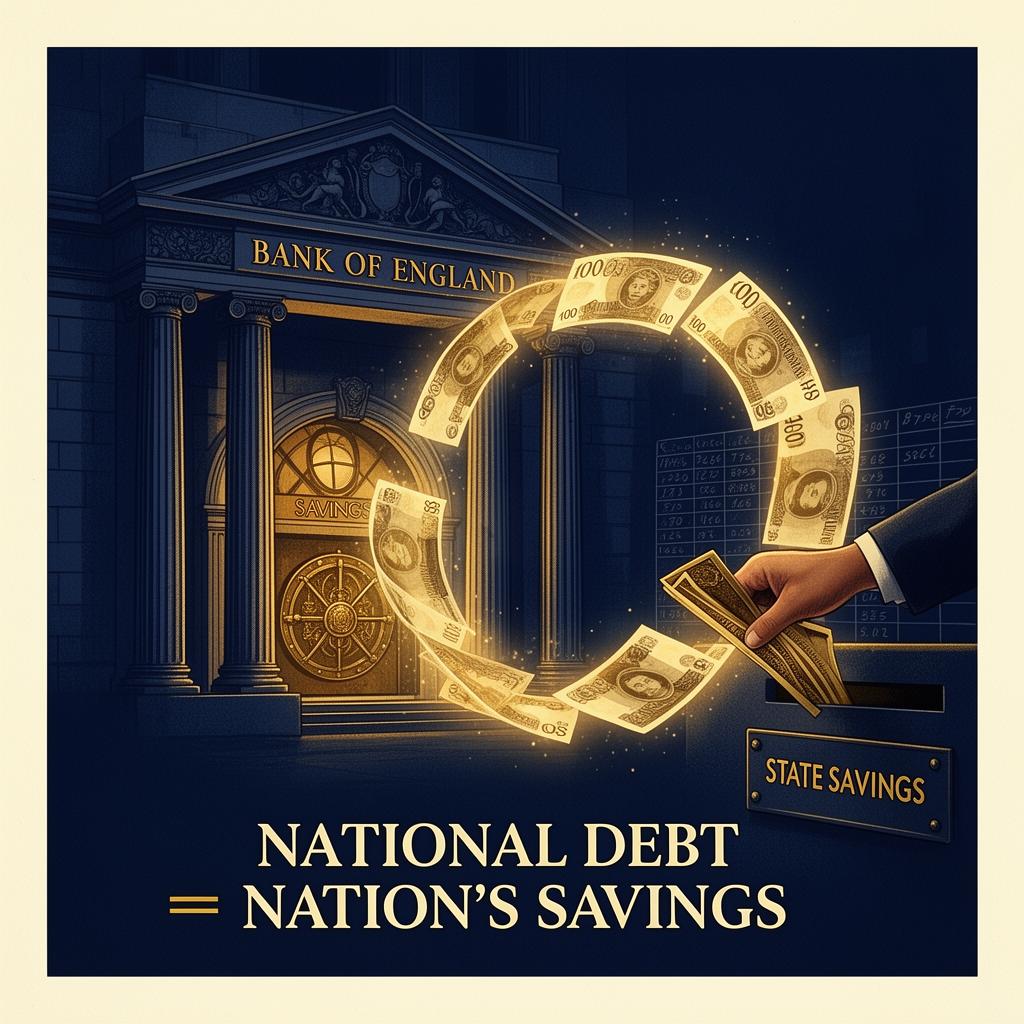
What we are taught to call the national debt is not debt at all. It is the nation's savings — and the austerity story we have been sold is built on a misunderstanding of how money actually works.
As a matter of plain fact, the UK government cannot borrow. I know how that sounds. Almost everyone has been told the opposite — that we have a debt crisis, that we are borrowing too much, that one day we may not be able to repay it. So let me be clear about what I mean, because the difference between "borrowing" and what is really happening is the difference between a country trapped by austerity and a country that understands its own power. For the underlying mechanics, see money is a promise: how money is really created and Modern Monetary Theory explained.
The government cannot borrow because it makes all the money that is deposited with it. It even chooses how much is deposited. As a consequence, it is not really borrowing at all. It is offering people a savings facility. We do not say a bank is "borrowing" when you pay money into your account — so why do we say the government is borrowing when people place money with it? Once you see the system clearly, the whole vocabulary of national debt falls apart.
01 · Who makes the pound?
Every pound in existence is created, directly or indirectly, by the state. Sterling is our currency, we have only one, and it is the one the state issues. The government also creates all of the UK's base money — the notes, coins, and central-bank reserves that underpin the entire banking system.
Yes, commercial banks create money too. When a bank makes a loan, it creates new deposits, and those deposits form part of the money supply. But banks can only do this because they are licensed by the Bank of England. Every single pound created in the UK is created directly or indirectly under the control of the Bank — and therefore of the government, which has owned the Bank outright since the Bank of England Act 1946.
A user of a currency can run out of money. The issuer of that currency cannot. The UK government is the issuer.
| Question | A household | The UK government |
|---|---|---|
| Can it create pounds? | No | Yes — it issues them |
| Must it earn or borrow before it spends? | Yes | No — it spends money into existence |
| Can it be forced into insolvency in £? | Yes | No |
| Does it own its own bank? | No | Yes — the Bank of England, since 1946 |
| What is its 'debt', really? | Money owed to others | Money it created, now saved with it |
02 · The overdraft that nets to nothing
Under the gold standard, the rule was that the government should not run an overdraft with the Bank of England. There were technical reasons for that in a world where money was tied to gold. None of them survive in today's system of free-floating fiat currency. The convention was, in fact, routinely ignored: such overdrafts were genuinely run right up until 2006.
Since then we have entered a strange new ritual. Each day the government insists it must take in whatever sum is needed to clear its overdraft with the Bank of England — even though the overdraft is meaningless, because the government owns the Bank. The two balances net out. We have built an entire politics of fear on top of an internal accounting entry.
- Pre-1971
Gold-standard logic: the government should not overdraw at the Bank of England. The rule made sense when money was convertible to gold.
- 1971
The gold standard ends. Sterling becomes a free-floating fiat currency. The original reason for the rule disappears.
- Up to 2006
The Ways and Means overdraft — the government's account at the Bank — is genuinely used. The convention is honoured more in the breach.
- 2006 onward
The government commits to clearing its overdraft daily, 'borrowing' from the markets to do so — a self-imposed rule, not an economic necessity.
- 2020
During the pandemic the Ways and Means facility was openly extended once more. The overdraft still exists; the state simply chooses, most of the time, to dress it up as borrowing.
To meet this self-imposed rule, the government deliberately plans to take in savings from the financial markets. It then pays interest on those deposits, and the whole arrangement is labelled "government borrowing." That label may have been technically true under the gold standard. It is not true now — because this is not borrowing out of a fixed pot of money. It is the government taking back money it created in the first place. It cannot borrow back what it created.
03 · When the state bought its own "debt"
If you doubt that the government and its bank net out, look at what quantitative easing actually did. Through the Bank of England's Asset Purchase Facility, the Bank bought gilts on a vast scale. At the peak it held around £875 billion of gilts: roughly one third of all UK government debt in issue.
For a third of the so-called national debt, the borrower (the Treasury) and the lender (the Bank of England) were the same public body. Between 2013 and 2022 alone, the facility transferred around £124 billion of coupon interest back to the Treasury. The debt the government owed to itself was, in any meaningful sense, not a debt at all. The City's grip on the rest of the market is dissected in the City is holding Britain hostage.
04 · What the "national debt" really is
Here is the cleanest way to see it. The total amount of base money the government has created and injected into the economy is the net of all its spending across history, less all the tax it has reclaimed across history. The difference — what is left in our hands — is what we call the national debt. But it is more accurately described as the government money supply: the stock of pounds the state has issued and left in circulation. The same identity in different language drives UK national debt as the nation's savings.
05 · Gilts are just savings accounts
The state already operates an explicit savings facility for ordinary people: National Savings & Investments. More than £240 billion sits there at any moment, held by some 25 million savers, every penny backed by the Treasury. Nobody calls Premium Bonds "the government borrowing from grannies." We call it saving — because that is what it is.
For those with far more to deposit — banks, pension funds, insurers, overseas governments — there is the government bond market. But a gilt is the same thing as an NS&I account. It is a safe, interest-bearing deposit with the state. The only difference is the wrapper.
| NS&I (retail) | Gilts (wholesale) | |
|---|---|---|
| Who uses it | Households, ordinary savers | Pension funds, banks, insurers, overseas savers |
| What it is | A deposit with the state | A deposit with the state |
| Backed by | HM Treasury, 100% | HM Treasury, 100% |
| Pays | Interest / prizes | Interest (the coupon) |
| Honest name | Saving | Saving |
| Official name | Saving | 'Borrowing' |
06 · The one genuine objection — and it isn't affordability
None of this means the state can spend without limit. There is a real constraint — but it is not running out of money. The genuine limit is inflation: whether there are real resources, workers, materials and capacity to match new spending. Spend beyond what the economy can produce and you get rising prices, not bankruptcy. The empirical case is dissected in did central banks actually beat inflation?
The other real issue is distribution. Interest on these deposits flows to those who already hold the most wealth. Built into the operation of the gilt market is a quiet redistribution from those with the least to those with the most — arranged and paid for by the government. With debt-interest costs now running at scores of billions a year, that is a serious transfer. Whether to redirect it into productive UK investment is the question explored in the City will never fund small business.
07 · Treat gilts as what they are: state savings
If the government does not borrow — and it does not, it cannot, and it never will, because it takes deposits instead — then we should talk about gilts as state savings products. We should manage them so they do some good.
| Stop doing this | Start doing this |
|---|---|
| Treating gilts as a borrowing limit on the state | Treating them as a savings facility the state provides |
| Using 'the debt' to justify austerity | Judging spending against real resources and inflation |
| Paying ever-higher interest to wealth-holders | Minimising interest; offering safety, not profit |
| Letting savings sit idle in the wrapper | Channelling them into productive UK investment |
| Scaring the public with crisis language | Explaining the system honestly |
In a sentence — let's stop the pretence
The UK government cannot borrow. It creates the pounds that are saved with it. What is labelled as debt is savings placed on deposit with the state — a vote of confidence in the safest institution in the country. Let us drop the austerity logic that depends on the misunderstanding, and use the capacity of the state for economic and tax justice.
Continue with our companion explainers: money is a promise, MMT explained, national debt as savings, the manual pattern stealth strategy, how to develop a trading strategy, how to backtest MT5 and trending topics.
Figures drawn from official UK sources, including the ONS, the Bank of England's Asset Purchase Facility reports, and NS&I (national debt ~£2.91tn / ~94% of GDP at March 2026; NS&I holdings over £240bn; QE peak gilt holdings ~£875bn). This article sets out a heterodox, monetary-sovereignty reading of the public finances and is intended as commentary and education, not financial advice.
From The Blog
Explore more long-reads on markets, money & policy →
Deep dives on monetary policy, the bond markets, prop firms and the tools serious traders use on MT5.